March 15, 2026
Healing of the Blind Man
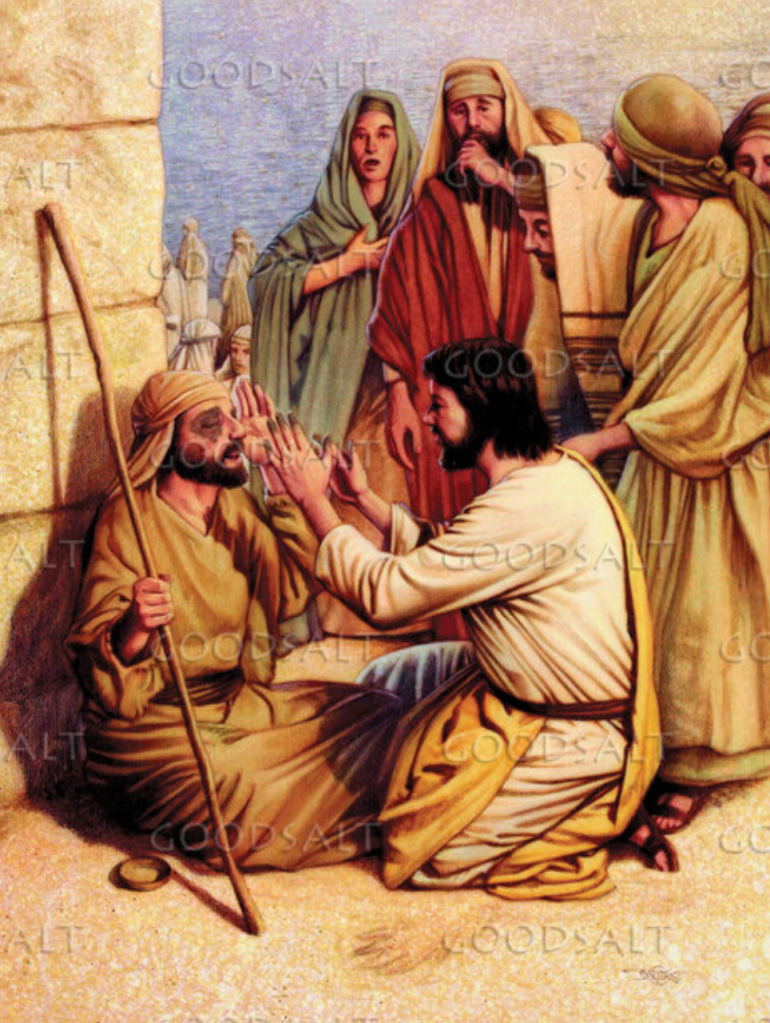
Gospel: (Shorter Form) John 9:1, 6-9, 13-17, 34-38
As Jesus passed by, He saw a man who had been blind from birth.
6 When He had said this, He spit on the ground, and made mud from the saliva, and applied the mud to his eyes, 7 and said to him, “Go, wash in the pool of Siloam” (which is translated, Sent). So he left and washed, and came back seeing. 8 So the neighbors, and those who previously saw [a]him as a beggar, were saying, “Is this not the one who used to sit and beg?” 9 Others were saying, “This is he,” still others were saying, “No, but he is like him.” [b]The man himself kept saying, “I am the one.”
13 They *brought [c]the man who was previously blind to the Pharisees. 14 Now it was a Sabbath on the day that Jesus made the mud and opened his eyes. 15 Then the Pharisees also were asking him again how he received his sight. And he said to them, “He applied mud to my eyes, and I washed, and I see.” 16 Therefore some of the Pharisees were saying, “This Man is not from God, because He does not keep the Sabbath.” But others were saying, “How can a man who is a sinner perform such [d]signs?” And there was dissension among them. 17 So they said again to the man who was blind, “What do you say about Him, since He opened your eyes?” And he said, “He is a prophet.”
34 They answered him, “You were born entirely in sins, and yet you are teaching us?” So they [i]put him out.
35 Jesus heard that they had [j]put him out, and upon finding him, He said, “Do you believe in the Son of Man?” 36 He answered [k]by saying, “And who is He, [l]Sir, that I may believe in Him?” 37 Jesus said to him, “You have both seen Him, and He is the One who is talking with you.” 38 And he said, “I believe, Lord.” And he worshiped Him.
Gospel Commentary:
The narrative of the man born blind in John 9 is a masterpiece of Johannine irony. It moves from physical darkness to spiritual sight, contrasting the “blindness” of the religious elite with the “vision” of a beggar.
This interpretation also linked to our Diocesan theme, “A Listening and Discerning Church That Walks With the Poor.”
Exegetical Interpretation
1. The Divine Initiative (John 9:1, 6-9)
The story begins with Jesus seeing a man whom others merely viewed as a theological puzzle. The disciples ask about the “cause” of his suffering (sin), but Jesus shifts the focus to the purpose: that the works of God might be revealed.
- The Act: Jesus uses spit and mud—reminiscent of the creation of Adam in Genesis—to “remake” the man’s eyes.
- The Command: He is sent to the pool of Siloam (meaning “Sent”). Healing requires the man’s cooperation; he must walk, even while still blind, to the water.
2. The Conflict of Vision (John 9:13-17)
The healing triggers a legalistic crisis. Because it occurred on the Sabbath, the Pharisees cannot see the miracle; they only see a violation.
- The Divide: The community is “divided. Some focus on the rule-breaking, while others grapple with the miracle.
3. The Rejection and the Encounter (John 9:34-38)
The religious leaders, unable to handle the man’s logic, “cast him out”. This excommunication is the climax of his social suffering.
- The Search: Hearing he was cast out, Jesus finds him. This is the core of the Gospel: God seeks those whom the institution discards.
- The Confession: Jesus reveals himself as the Son of Man. The man’s journey is complete: from “the man called Jesus” to “Prophet” to “Lord.” He falls down and worships.
Relating to the Diocesan Theme
“A Listening and Discerning Church That Walks with the Poor”
A Listening and Discerning Church
In the text, the neighbors and Pharisees talk about the man, but rarely to him with empathy. A listening Church imitates Jesus, who hears the silent cry of the man by the wayside. Listening means acknowledging the poor not as “projects” or “theological problems” to be solved, but as subjects of their own stories.
The Pharisees failed to discern because they were blinded by rigid interpretations of the law. A discerning Church looks for where the “works of God” are manifest in the margins. It asks: Is God moving in this person’s life, even if it doesn’t fit our traditional expectations? True discernment recognizes the “light of the world” in unexpected places.
Reflection Questions:
- Who are the “blind” in our community? Do we look at the poor and see a “problem of sin/laziness” to be analyzed, or a “work of God” waiting to be revealed?
- When have we acted like the Pharisees? Is our adherence to “the way things have always been done” preventing us from seeing the new things that God is doing in the lives of the marginalized?
- Are we a “Siloam” (Sent) people? How is our parish specifically “walking” with those who have been “cast out” by society or the church today?
 We are the Basic Ecclesial Communities (BEC's) of the Parish of St. James the Great, Ayala Alabang Village. The BEC is a new way of being a church. We bring the church into the neighborhood by making Jesus and the Good News felt by our neighbors through Fellowship, Prayer, Outreach, and Formation activities.
Leave a comment