Palm Sunday
March 29, 2026
Jesus is Judged and Crucified
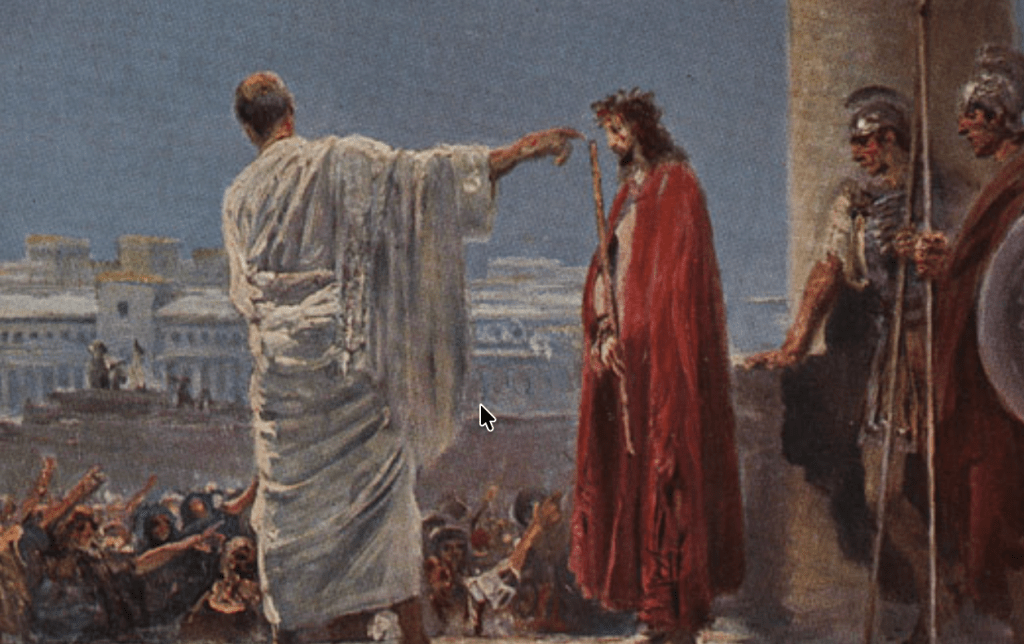
Gospel: Matthew 27: 11-54 (Shorter Form)
11 Now Jesus stood before the governor, and the governor questioned Him, saying, “So You are the King of the Jews?” And Jesus said to him, “It is as you say.” 12 And while He was being accused by the chief priests and elders, He did not offer any answer. 13 Then Pilate *said to Him, “Do You not hear how many things they are testifying against You?” 14 And still He did not answer him in regard to even a single [e]charge, so the governor was greatly amazed.
15 Now at the Passover Feast the governor was accustomed to release for the [f]people any one prisoner whom they wanted. 16 And at that time they were holding a notorious prisoner called Barabbas. 17 So when the people gathered together, Pilate said to them, “Whom do you want me to release for you: Barabbas, or Jesus who is called Christ?” 18 For he knew that it was because of envy that [g]they had handed Him over.
19 And while he was sitting on the judgment seat, his wife sent him a message, saying, “See that you have nothing to do with that righteous Man; for [h]last night I suffered greatly in a dream because of Him.” 20 But the chief priests and the elders persuaded the crowds to ask for Barabbas, and to put Jesus to death. 21 And the governor [i]said to them, “Which of the two do you want me to release for you?” And they said, “Barabbas.” 22 Pilate *said to them, “Then what shall I do with Jesus who is called Christ?” They all *said, “[j]Crucify Him!” 23 But he said, “Why, what evil has He done?” Yet they kept shouting all the more, saying, “[k]Crucify Him!”
24 Now when Pilate saw that he was accomplishing nothing, but rather that a riot was starting, he took water and washed his hands in front of the crowd, saying, “I am innocent of this Man’s blood; you yourselves shall see.” 25 And all the people replied, “His blood shall be on us and on our children!” 26 Then he released Barabbas [l]for them; but after having Jesus flogged, he handed Him over to be crucified.
Jesus Is Mocked
27 Then the soldiers of the governor took Jesus into the [m]Praetorium and gathered the whole Roman [n]cohort to Him. 28 And they stripped Him and put a red [o]cloak on Him. 29 And after twisting together a crown of thorns, they put it on His head, and put a [p]reed in His right hand; and they knelt down before Him and mocked Him, saying, “Hail, King of the Jews!” 30 And they spit on Him, and took the reed and beat Him on the head. 31 And after they had mocked Him, they took the cloak off Him and put His own garments back on Him, and led Him away to crucify Him.
32 As they were coming out, they found a man of Cyrene named Simon, [q]whom they compelled to carry His [r]cross.
The Crucifixion
33 And when they came to a place called Golgotha, which means Place of a Skull, 34 they gave Him wine mixed with [s]bile to drink; and after tasting it, He was unwilling to drink it.
35 And when they had crucified Him, they divided His garments among themselves by casting [t]lots. 36 And sitting down, they began to keep watch over Him there. 37 And above His head they put up the charge against Him [u]which read, “THIS IS JESUS THE KING OF THE JEWS.”
38 At that time two [v]rebels *were being crucified with Him, one on the right and one on the left. 39 And those passing by were [w]speaking abusively to Him, shaking their heads, 40 and saying, “You who are going to destroy the temple and rebuild it in three days, save Yourself! If You are the Son of God, come down from the cross.” 41 In the same way the chief priests also, along with the scribes and elders, were mocking Him and saying, 42 “He saved others; [x]He cannot save Himself! He is the King of Israel; let Him now come down from the cross, and we will believe in Him. 43 He has trusted in God; let God rescue Him now, if He [y]takes pleasure in Him; for He said, ‘I am the Son of God.’” 44 And the [z]rebels who had been crucified with Him were also insulting Him in the same way.
45 Now from the [aa]sixth hour darkness [ab]fell upon all the land until the [ac]ninth hour. 46 And about the ninth hour Jesus cried out with a loud voice, saying, “Eli, Eli, lema sabaktanei?” that is, “My God, My God, why have You forsaken Me?” 47 And some of those who were standing there, when they heard it, said, “This man is calling for Elijah.” 48 And immediately one of them ran, and taking a sponge, he filled it with sour wine and put it on a reed, and gave Him a drink. 49 But the rest of them said, “[ad]Let us see if Elijah comes to save Him[ae].” 50 And Jesus cried out again with a loud voice, and gave up His spirit. 51 And behold, the [af]veil of the temple was torn in two from top to bottom; and the earth shook and the rocks were split. 52 Also the tombs were opened, and many bodies of the [ag]saints who had fallen asleep were raised; 53 and coming out of the tombs after His resurrection, they entered the holy city and appeared to many. 54 Now as for the centurion and those who were with him keeping guard over Jesus, when they saw the earthquake and the other things that were happening, they became extremely frightened and said, “Truly this was [ah]the Son of God!”
Gospel Commentary:
The Passion narrative in Matthew 27:11-54 represents the ultimate “walk” with the poor and the marginalized. It is the story of God entering the depths of human injustice, abandonment, and death.
1. The Silence of the King (vv. 11–14, 20–26)
Before Pilate, Jesus remains largely silent. In Matthew’s Gospel, this silence is not a sign of defeat but a fulfillment of the “Suffering Servant” (Isaiah 53:7).
- The Contrast: While the crowds are manipulated by the religious elite to shout for Barabbas (an insurrectionist), Jesus—the true liberator—accepts the role of the sacrificial lamb.
- The Power Shift: Pilate, despite his Roman authority, is “amazed” and eventually cowed by the mob. The “poor” Jesus holds the moral authority that the “powerful” Pilate lacks.
2. The Mockery and the Kingly Identity (vv. 27–31, 35–44)
The Roman soldiers and the passersby mock Jesus using the symbols of royalty: a scarlet robe, a crown of thorns, and a reed.
- The Irony: They mock what is actually true. Jesus is a King, but his kingdom is built on vulnerability rather than violence.
- The Taunt: The challenge “If you are the Son of God, come down” echoes the temptations in the desert. Jesus “saves” others by refusing to “save” himself.
3. The Cry of Abandonment and the Cosmic Response (vv. 45–54)
Jesus’ cry, “My God, my God, why have you forsaken me?” (Psalm 22), marks his total identification with the “anawim”—the poor who have nothing left but God.
- The Temple Veil: The tearing of the veil from top to bottom signifies that God is no longer “locked away” in a sanctuary. He is now accessible to all through the broken body of Christ.
- The Centurion’s Recognition: The first person to “discern” Jesus’ identity after his death is not a disciple or a priest, but a Roman centurion—an outsider and a “Gentile”—who sees the truth in the midst of the earthquake.
Connection to the Diocesan Theme
A Listening and Discerning Church that Walks with the Poor
- Listening to the Silent: In the Passion, Jesus is the “poor one” who is silenced by the system. A Listening Church pays attention to those whose voices are drowned out by the “crowds” or by unjust structures.
- Discerning True Justice: Pilate failed to discern the truth because he was afraid of the people. A Discerning Church seeks God’s will even when it is unpopular, choosing the “Christ” over the “Barabbas” of easy, violent, or temporary fixes.
- Walking the Way of the Cross: To “walk with the poor” is to follow the path to Golgotha. It means standing with those who are being “crucified” today by poverty, hunger, or rejection, and recognizing the face of God in their suffering.
Reflection Questions for Basic Ecclesial Communities (BECs)
- The Barabbas Choice: In our local community, do we sometimes choose “Barabbas” (shortcuts, anger, or popular but harmful trends) over the quiet, difficult way of Jesus (peace, honesty, and sacrifice)?
- Standing at the Foot of the Cross: When a family in our BEC is going through a “Calvary” (a crisis like losing a job or a death in the family), do we “flee” like the disciples, or do we have the courage to “stay” and walk with them through the darkness?
- Recognizing the Son of God: The Centurion saw God in a broken, dying man. This week, how can we practice “discerning” the presence of Jesus in the “least” of our neighbors—the street dwellers, the sick, or the difficult person in our street?
 We are the Basic Ecclesial Communities (BEC's) of the Parish of St. James the Great, Ayala Alabang Village. The BEC is a new way of being a church. We bring the church into the neighborhood by making Jesus and the Good News felt by our neighbors through Fellowship, Prayer, Outreach, and Formation activities.
Leave a comment