Second Sunday of Easter
April 12, 2026
Doubting Thomas
Gospel: John 20:19-31
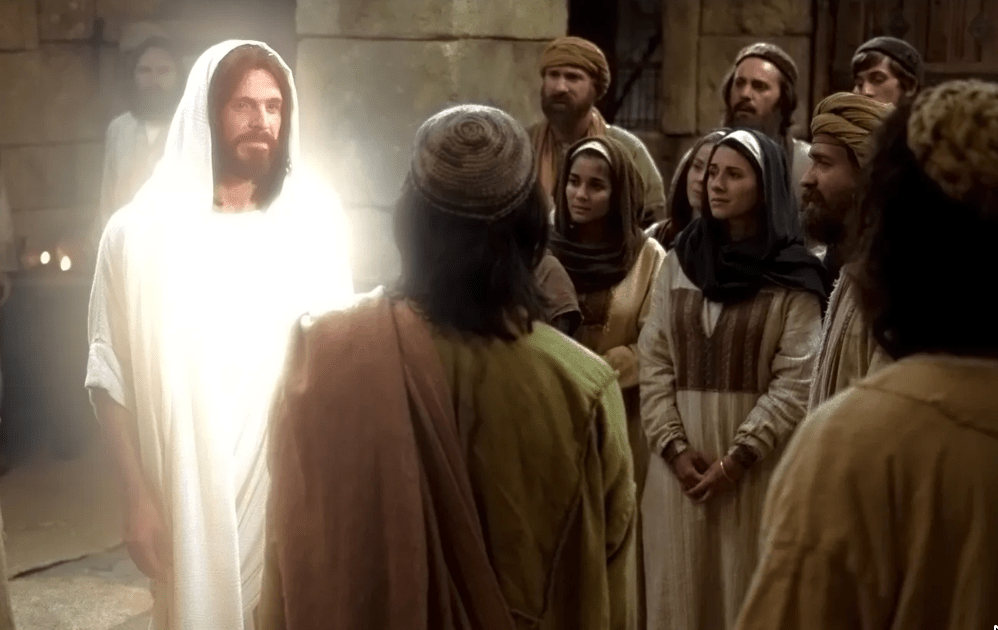
19 Now when it was evening on that day, the first day of the week, and when the doors were [a]shut where the disciples were together due to fear of the [b]Jews, Jesus came and stood in their midst, and *said to them, “Peace be to you.” 20 And when He had said this, He showed them both His hands and His side. The disciples then rejoiced when they saw the Lord. 21 So Jesus said to them again, “Peace be to you; just as the Father has sent Me, I also send you.” 22 And when He had said this, He breathed on them and *said to them, “Receive the Holy Spirit. 23 If you forgive the sins of any, their sins [c]have been forgiven them; if you retain the sins of any, they have been retained.”
24 But Thomas, one of the twelve, who was called [d]Didymus, was not with them when Jesus came. 25 So the other disciples were saying to him, “We have seen the Lord!” But he said to them, “Unless I see in His hands the imprint of the nails, and put my finger into the place of the nails, and put my hand into His side, I will not believe.”
26 [e]Eight days later His disciples were again inside, and Thomas was with them. Jesus *came, the doors having been [f]shut, and stood in their midst and said, “Peace be to you.” 27 Then He *said to Thomas, “Place your finger here, and see My hands; and take your hand and put it into My side; and do not continue in disbelief, but be a believer.” 28 Thomas answered and said to Him, “My Lord and my God!” 29 Jesus *said to him, “Because you have seen Me, have you now believed? Blessed are they who did not see, and yet believed.”
Gospel Commentary:
This passage, often referred to as the “Doubting Thomas” narrative, captures the transition of the early Christian community from a state of paralyzed fear to a dynamic mission fueled by the Holy Spirit.
1. The Peace of the Risen Christ (vv. 19-21) The disciples are huddled behind “locked doors” for fear of the authorities. This represents a community in crisis—isolated and afraid. Jesus enters their midst, not with a rebuke for their abandonment, but with the greeting: “Peace be with you.” This Shalom is more than a hello; it is the restoration of wholeness. He shows them his wounds, proving that the Risen Lord is the same one who suffered.
2. The Mission and the Spirit (vv. 22-23) Jesus breathes on them, echoing the creation of man in Genesis. He gives them the Holy Spirit, transforming the fearful group into an apostolic community. The power to forgive sins is delegated to the community, emphasizing that the BEC’s primary role is to be a vessel of God’s mercy and reconciliation in the neighborhood.
3. The Journey of Thomas (vv. 24-29) Thomas’s struggle is not necessarily a lack of faith, but a missed encounter—he wasn’t with the community when Jesus first came. This highlights the importance of the gathering. When he finally encounters Christ, he utters the most profound Christological confession in the Gospels: “My Lord and my God!”
Reflection Questions
For Individual Reflection:
- The “Locked Doors” of the Heart: What are the “fears” or “locked doors” in my life right now that prevent me from fully experiencing the peace of Christ? How can I invite Jesus into those hidden spaces?
- Touching the Wounds: Thomas wanted to touch the wounds of Jesus. Where do I see the “wounds” of Christ in my family or workplace today, and how am I being called to bring healing to them?
- Building the “Community of Witness”: Thomas missed the first encounter because he was away from the group. How can our BEC become a more welcoming and vibrant space so that no member feels “away” or isolated, and everyone can encounter the Risen Lord through our collective love and support?
 We are the Basic Ecclesial Communities (BEC's) of the Parish of St. James the Great, Ayala Alabang Village. The BEC is a new way of being a church. We bring the church into the neighborhood by making Jesus and the Good News felt by our neighbors through Fellowship, Prayer, Outreach, and Formation activities.
Leave a comment