3rd Sunday of Lent, March 8, 2026
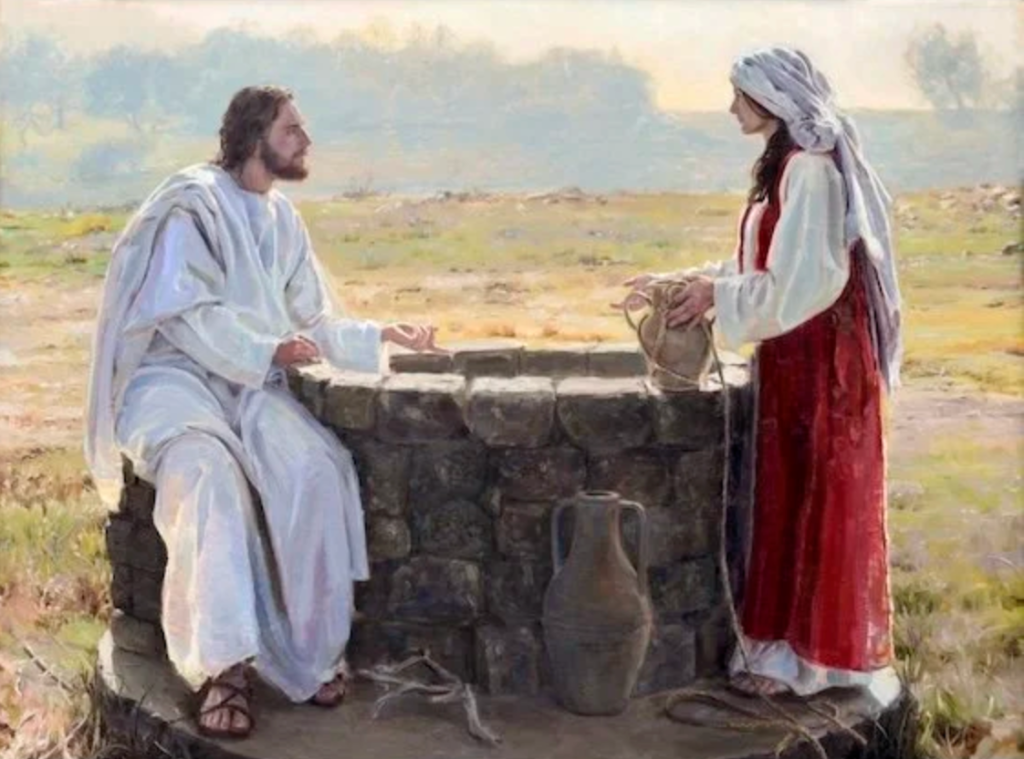
Jesus and the Samaritan Woman by Jacob’s Well
-
John 4:5-15, 19-6, 39, 40-42
5 So he came to a town of Samaria called Sychar,[a] near the plot of land that Jacob had given to his son Joseph. 6 Jacob’s well was there. Jesus, tired from his journey, sat down there at the well. It was about noon.
7 A woman of Samaria came to draw water. Jesus said to her, “Give me a drink.” 8 His disciples had gone into the town to buy food. 9 [b]The Samaritan woman said to him, “How can you, a Jew, ask me, a Samaritan woman, for a drink?” (For Jews use nothing in common with Samaritans.) 10 [c]Jesus answered and said to her, “If you knew the gift of God and who is saying to you, ‘Give me a drink,’ you would have asked him and he would have given you living water.” 11 [The woman] said to him, “Sir,[d] you do not even have a bucket and the well is deep; where then can you get this living water? 12 Are you greater than our father Jacob, who gave us this well and drank from it himself with his children and his flocks?” 13 Jesus answered and said to her, “Everyone who drinks this water will be thirsty again; 14 but whoever drinks the water I shall give will never thirst; the water I shall give will become in him a spring of water welling up to eternal life.” 15 The woman said to him, “Sir, give me this water, so that I may not be thirsty or have to keep coming here to draw water.”
The woman said to him, “Sir, I can see that you are a prophet. 20 Our ancestors worshiped on this mountain;[a] but you people say that the place to worship is in Jerusalem.” 21 Jesus said to her, “Believe me, woman, the hour is coming when you will worship the Father neither on this mountain nor in Jerusalem. 22 You people worship what you do not understand; we worship what we understand, because salvation is from the Jews. 23 But the hour is coming, and is now here, when true worshipers will worship the Father in Spirit and truth;[b] and indeed the Father seeks such people to worship him. 24 God is Spirit, and those who worship him must worship in Spirit and truth.” 25 [c]The woman said to him, “I know that the Messiah is coming, the one called the Anointed; when he comes, he will tell us everything.” 26 Jesus said to her, “I am he,[d] the one who is speaking with you.
39 Many of the Samaritans of that town began to believe in him because of the word of the woman[a] who testified, “He told me everything I have done.”
40 When the Samaritans came to him, they invited him to stay with them; and he stayed there two days. 41 Many more began to believe in him because of his word, 42 and they said to the woman, “We no longer believe because of your word; for we have heard for ourselves, and we know that this is truly the savior of the world.”Commentary:
The encounter between Jesus and the Samaritan woman at Jacob’s Well is a masterclass in breaking social barriers and the power of transformative listening. It moves from a physical need (water) to a spiritual reality (eternal life) and results in a community-wide conversion. It is so in line with our Diocesan theme for 2026: A Listening and Discerning Church that Walks With The Poor.
1. The Setting of Scarcity and Stigma (v. 5–9)
Jesus arrives at Sychar, tired and thirsty. By asking the woman for a drink, he shatters three major barriers: gender (rabbis didn’t speak to women in public), ethnicity (Jews vs. Samaritans), and moral/social status (she is drawing water at noon, likely to avoid the judgment of other women). Jesus makes himself vulnerable by needing her help, modeling a Church that meets people in their poverty and exhaustion.
2. The Living Water (v. 10–15)
The dialogue shifts from hydōr (physical water) to hydōr zōn (living water). In the Old Testament, God is the “fountain of living water” (Jeremiah 2:13). Jesus claims to be the source of a grace that wells up from within, offering a dignity that the world’s “wells” (status, relationships, rituals) cannot provide.
3. Truthful Discernment (v. 19–24)
When the woman attempts to pivot to a theological debate about the “correct” mountain for worship, Jesus redirects her to the heart of the matter: Spirit and Truth. True worship is not about geography but about a relational alignment with God. He discerns her past not to condemn her, but to reveal that he truly “sees” her.
4. The Revelation and the Mission (v. 25–26, 39–42)
Jesus reveals his identity as the Messiah (“I am he”) to a marginalized woman—the first such explicit revelation in John’s Gospel. Her testimony, “He told me everything I ever did,” causes the townspeople to move from hearsay to personal encounter. The “poor” in spirit become the primary evangelizers.
Reflection Questions: A Listening and Discerning Church
In light of the diocesan theme, “A listening and discerning Church that walks with the poor,” consider the following:
I. A Listening Church
- The woman’s “poverty” was both social and spiritual. When we encounter those who are excluded, do we listen to their actual story, or do we listen to the “labels” the world has placed on them?
II. A Discerning Church
- Jesus discerned that the woman’s thirst was deeper than physical water. As a Church, how do we discern the root causes of poverty and exclusion in our own neighborhoods rather than just addressing the symptoms?
III. Walking with the Poor
- Jesus stayed with the Samaritans for two days (v. 40). He didn’t just perform a “drive-by” miracle. What does it look like for our BECs to “stay” and walk with the poor for the long haul, rather than offering one-time charity?
The Samaritan woman became the bridge for her entire town. Do we recognize the poor not just as “recipients of help,” but as having a voice who, through their lives, can also evangelize us?
 The BEC's of the Parish of St. James the Great. We are a vibrant community of communities joyfully journeying towards being a Church of the Poor.