
Forgive Seventy-seven Times, 24th Sunday in Ordinary Time, Sept. 13, 2026
Gospel: Matthew 18:21-35
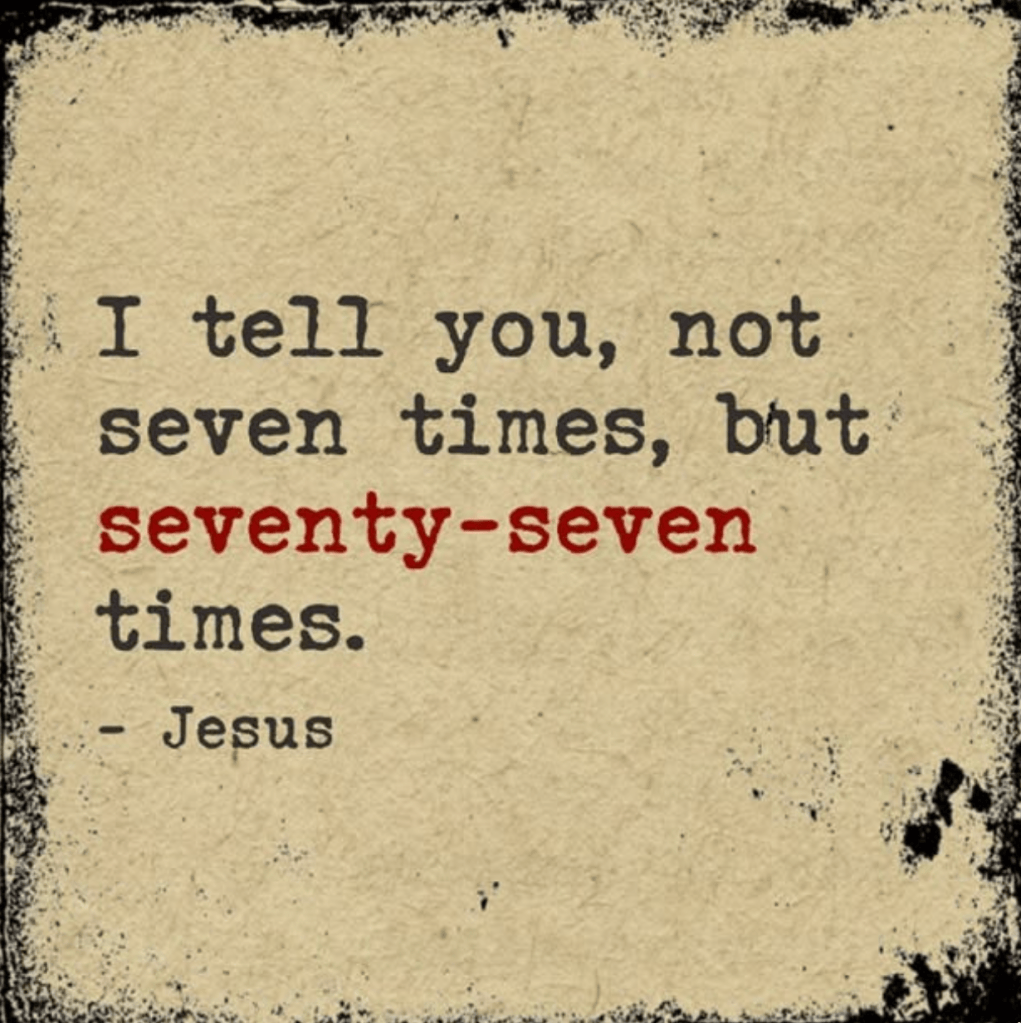
21 Then Peter came up and said to Him, “Lord, how many times shall my brother sin against me and I still forgive him? Up to seven times?” 22 Jesus *said to him, “I do not say to you, up to seven times, but up to [a]seventy-seven times.
23 “For this reason the kingdom of heaven [b]is like a king who wanted to settle accounts with his slaves. 24 And when he had begun to settle them, one who owed him [c]ten thousand talents was brought to him. 25 But since he [d]did not have the means to repay, his master commanded that he be sold, along with his wife and children and all that he had, and repayment be made. 26 So the slave fell to the ground and prostrated himself before him, saying, ‘Have patience with me and I will repay you everything.’ 27 And the master of that slave felt compassion, and he released him and forgave him the [e]debt.
28 But that slave went out and found one of his fellow slaves who owed him a hundred [f]denarii; and he seized him and began to choke him, saying, ‘Pay back what you owe!’ 29 So his fellow slave fell to the ground and began to plead with him, saying, ‘Have patience with me and I will repay you.’ 30 But he was unwilling, [g]and went and threw him in prison until he would pay back what was owed. 31 So when his fellow slaves saw what had happened, they were deeply grieved and came and reported to their master all that had happened. 32 Then summoning him, his master *said to him, ‘You wicked slave, I forgave you all that debt because you pleaded with me. 33 Should you not also have had mercy on your fellow slave, in the same way that I had mercy on you?’ 34 And his master, moved with anger, handed him over to the [h]torturers until he would repay all that was owed him. 35 My heavenly Father will also do the same to you, if each of you does not forgive his brother from your [i]heart.”
Gospel Commentary:
In Matthew 18:21-35, Peter asks Jesus if forgiving a neighbor seven times is enough. In Jewish tradition, three times was considered generous, so Peter believed he was being extraordinarily merciful. Jesus responds with “seventy-seven times” (or 70 x 7), showing that forgiveness in God’s kingdom must have no upper limit.
To drive this point home, Jesus tells the Parable of the Unforgiving Servant:
- The Impossible Debt: A servant owes the king 10,000 talents—an astronomical amount roughly equal to millions of days of labor. It represents a debt impossible for any human to pay back. Out of pure compassion, the king completely cancels it.
- The Petty Refusal: The same servant finds a fellow peer who owes him 100 denarii—a very small, manageable debt worth a few months’ wages. Instead of showing mercy, he chokes him and throws him in prison.
- The Contrast: The core issue is not arithmetic; it is a hardened heart. The first servant received boundless mercy but refused to let that mercy transform how he treated others.
Theological Implications for Basic Ecclesial Communities (BECs)
Basic Ecclesial Communities thrive on close relationships, shared struggles, and communal life. Matthew 18 directly addresses how small Christian communities can survive interpersonal conflicts.
- Forgiveness as the Lifeblood of Community: In a BEC, close proximity inevitably leads to misunderstandings, gossip, or hurt feelings. Jesus teaches that community cannot survive on strict “fairness” or keeping score. It survives on unending mercy.
- Mirroring God’s Grace: Our ability to forgive neighbors or fellow BEC members does not come from our own strength; it comes from remembering how much God has already forgiven us. Unforgiveness in a BEC breaks our connection with God’s mercy.
Reflection Questions
Personal Reflection (For Individual Prayer)
“Looking into my heart, who is the person I am currently refusing to forgive over a small or past offense, and how does remembering God’s immense mercy toward me help me release that grudge today?”
BEC Reflection (For Group Sharing)
“As a community, what are the past hurts, misunderstandings, or biases that we need to forgive together so that our BEC can truly be a living witness of God’s unconditional love in our neighborhood?”


Leave a Reply