
The Parable of the Wicked Servants, 27th Sunday of Ordinary Time, October 4, 2026
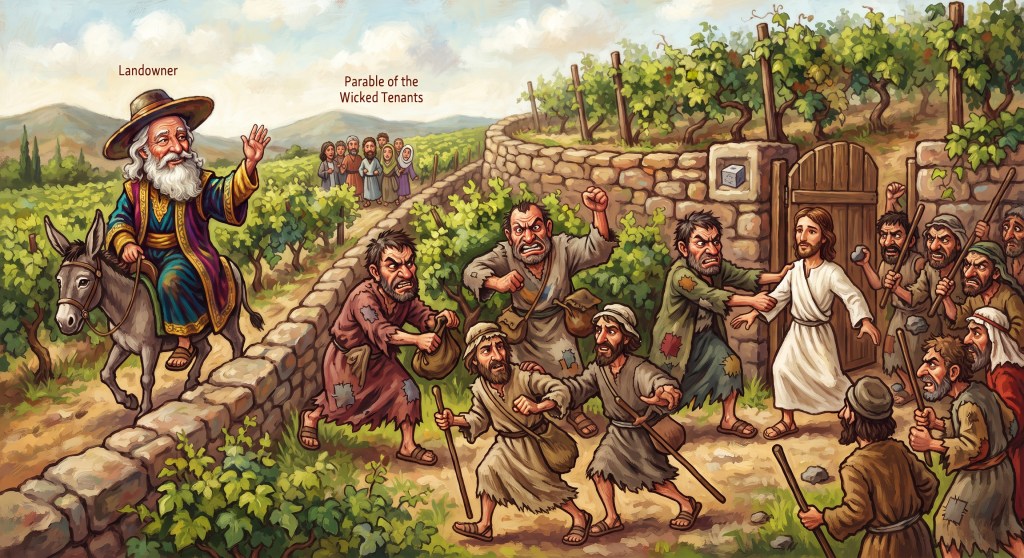
Gospel: Matthew 21:33-43
Parable of the Wicket Tenants
33 “Listen to another parable. There was a [a]landowner who planted a vineyard and put a fence around it, and dug a wine press in it, and built a tower, and he leased it to vine-growers and went on a journey. 34 And when the harvest time approached, he sent his slaves to the vine-growers to receive his fruit. 35 And the vine-growers took his slaves and beat one, killed another, and stoned another. 36 Again, he sent other slaves, more than the first; and they did the same things to them. 37 But afterward he sent his son to them, saying, ‘They will respect my son.’ 38 But when the vine-growers saw the son, they said among themselves, ‘This is the heir; come, let’s kill him and take possession of his inheritance!’ 39 And they took him and threw him out of the vineyard, and killed him. 40 Therefore, when the [e]owner of the vineyard comes, what will he do to those vine-growers?” 41 They said to Him, “He will bring those wretches to a wretched end and lease the vineyard to other vine-growers, who will pay him the fruit in the proper seasons.”
42 Jesus said to them, “Did you never read in the Scriptures,
‘A stone which the builders rejected,
This has become the [f]chief cornerstone;
This came about from the Lord,
And it is marvelous in our eyes’?
43 Therefore I say to you, the kingdom of God will be taken away from you and given to a people producing its fruit.
Gospel Commentary
The Parable of the Wicked Tenants (Matthew 21:33–43)
What Does the Passage Mean?
- God’s Vineyard (v. 33): The landowner is God, and the vineyard is His chosen people. God gave us everything we need—love, protection, and grace.
- The Wicked Tenants (v. 34–39): The tenant farmers represent religious leaders who forgot they were just caretakers. Instead of honoring God, they rejected the prophets and even killed the landowner’s Son (Jesus) to keep the vineyard for themselves.
- The New Beginning (v. 40–43): Because the tenants refused to share the harvest, the vineyard is given to those who will bear good fruit. Jesus becomes the “cornerstone” of a brand new community of faith.
What Does This Mean for Our BEC?
- We are Caretakers, Not Owners: Our personal and community resources do not belong to any of us. Everything is a gift from God entrusted to all of us.
- Bearing Fruit Together: God expects us to produce a harvest of love, fellowship unity, and most especially, care for the poor. A vibrant BEC lives out the Gospel through daily action, not just words, and does not only look inward.
- The Strength of Ordinary People: Just as God chose the rejected stone to build something great, BECs remind us that God works powerfully through ordinary, simple neighborhood families.
Reflection Questions
1. For Personal Reflection:
“In what specific ways are you currently sharing the time, talents, and blessings God has given you, and where is God calling you to be more generous?”
2. For BEC Sharing:
“Looking at our neighborhood right now, what is one concrete need or struggle of a neighbor or family that our BEC can realistically help address this month?”


Leave a comment