
Jesus Walks on Water, 19th Sunday of Ordinary Time, August 9, 2026
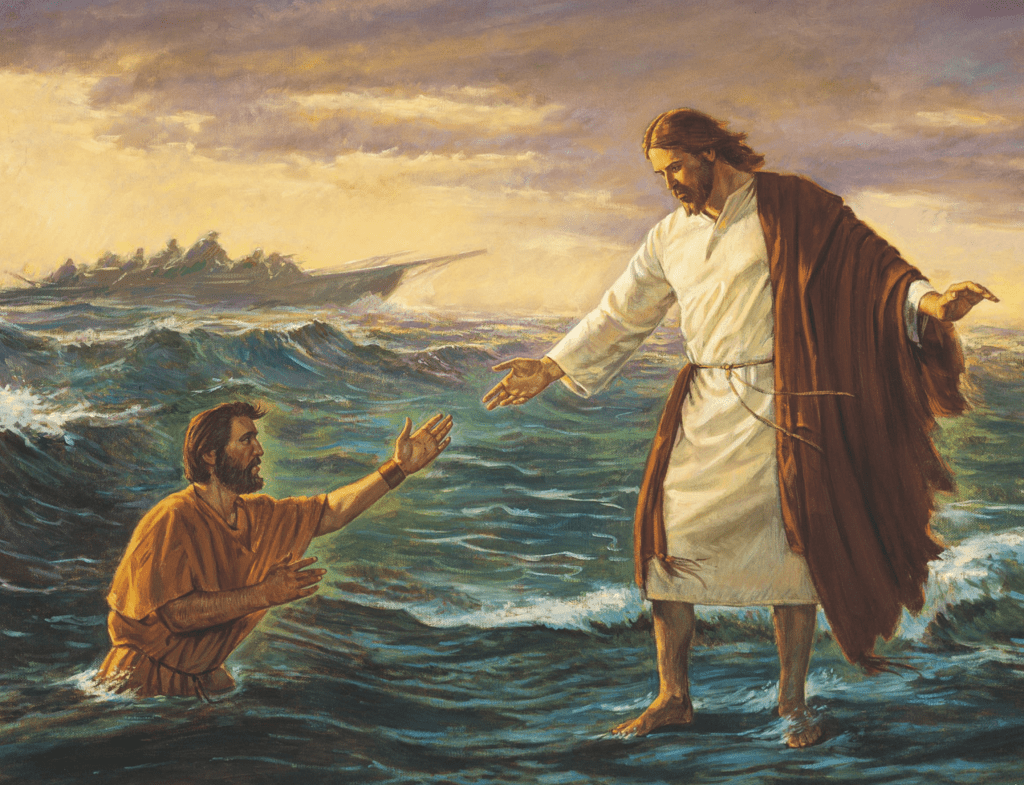
Gospel: Matthew 14:22-33
22 Immediately afterward He compelled the disciples to get into the boat and to go ahead of Him to the other side, while He sent the crowds away. 23 After He had sent the crowds away, He went up on the mountain by Himself to pray; and when it was evening, He was there alone. 24 But the boat was already [a]a long distance from the land, [b]battered by the waves; for the wind was [c]contrary. 25 And in the [d]fourth watch of the night He came to them, walking on the sea. 26 When the disciples saw Him walking on the sea, they were terrified, and said, “It is a ghost!” And they cried out [e]in fear. 27 But immediately Jesus spoke to them, saying, “Take courage, [f]it is I; do not be afraid.”
28 Peter responded and said to Him, “Lord, if [g]it is You, command me to come to You on the water.” 29 And He said, “Come!” And Peter got out of the boat and walked on the water, and came toward Jesus. 30 But seeing the wind, he became frightened, and when he began to sink, he cried out, saying, “Lord, save me!” 31 Immediately Jesus reached out with His hand and took hold of him, and *said to him, “You of little faith, why did you doubt?” 32 When they got into the boat, the wind stopped. 33 And those who were in the boat worshiped Him, saying, “You are truly God’s Son!”
Gospel Commentary:
(edited by Manny Blas)
Matthew 14:22–33 takes place immediately after the Feeding of the Five Thousand. In biblical imagery, the sea represents chaos, evil, and death, while the boat serves as an early Christian symbol for the Church, navigating a hostile world.
- Jesus’ Solitude and Prayer (vv. 22–23): Jesus compels the disciples to cross ahead while he goes up the mountain to pray. His communion with the Father grounds his authority and divine mission.
- The Fourth Watch and Epiphany (vv. 24–27): Arriving during the “fourth watch” (3:00 AM to 6:00 AM—the darkest hour before dawn), Jesus walks on water. In the Old Testament, walking on the sea is a divine prerogative reserved for Yahweh alone.
- Peter’s Venture and Sinking (vv. 28–31): Matthew is the only Gospel writer to include Peter’s walk on the water. Peter demonstrates bold initial faith by stepping out, but shifts his focus from Jesus to the fierce wind. His hesitation causes him to sink. Yet, Peter’s desperate cry—“Lord, save me!”—is the quintessential prayer of a disciple.
- The Calm and Worship (vv. 32–33): As soon as Jesus and Peter step into the boat, the wind dies down. The disciples react not just with relief, but with liturgical worship, declaring: “Truly, you are the Son of God.”
Significance for Basic Ecclesial Communities (BECs)
1. The Boat as the BEC Community
The boat battered by waves mirrors a small community facing socio-economic struggles, parish tensions, or personal trials. The passage reassures the BEC that Christ does not abandon his people to the storm; his presence remains active even when he seems distant.
2. Leadership and Shared Faith
Peter represents leadership within the BEC (lay leaders and Core Pillar heads). His journey highlights that Christian leadership is not about personal invincibility, but about keeping one’s eyes fixed on Christ. Leaders will stumble when overwhelmed by environmental “winds” (burnout, conflicts, doubt), but Christ’s hand is always extended to restore them.
3. Co-Responsibility in Mission
Stepping out of the boat symbolizes the BEC’s call to go beyond its comfort zone—engaging in social action, visiting the sick, or supporting impoverished neighbors. True discipleship requires “walking on water”—risking vulnerability and trusting God’s grace over human security.
Reflection Questions
For Personal Reflection
When the “strong winds” of life hit, where do I direct my focus—on the overwhelming storm around me, or on Christ walking toward me? How can I make Peter’s cry, “Lord, save me!”, my daily prayer when I begin to sink?
For the BEC (Group Sharing)
In what ways is our BEC being called to “step out of the boat” into our surrounding neighborhood today? What collective fears or “winds” hold us back from trusting Jesus’ command to “Come”?


Leave a Reply